All
hail the most notorious pirate to ever maraud the eastern shores! All
hail the most notorious pirate to ever maraud the eastern shores!
Blackbeard was born in the late 17th-century in the English
port-city of Bristol, though there are no official records
of this. His name is not found anywhere until the last two
years of his life. Then the name "Edward Teach",
better known as 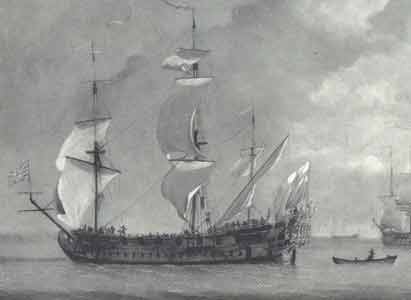 Blackbeard, appears with frequency in letters, newspaper articles,
and official documents, usually regarding his crimes. A personal log was also
recovered and several eyewitness accounts describe him in detail. A truly legendary
figure in American history, a look at his life reveals many interesting details
in addition to the gore-choked carnage you would expect from the terror of the
eastern seaboard. Blackbeard, appears with frequency in letters, newspaper articles,
and official documents, usually regarding his crimes. A personal log was also
recovered and several eyewitness accounts describe him in detail. A truly legendary
figure in American history, a look at his life reveals many interesting details
in addition to the gore-choked carnage you would expect from the terror of the
eastern seaboard.
Little Eddie Teach went to sea at an early age, signing on with the British Navy.
For an undetermined number of years he fought in the Queen Anne Wars against
Spain, distinguishing himself as a proficient sailor and expert shot. These years
gave him invaluable experience on how the English fought their ships and ran
their crews - experience he would one day use against them.
The war ended in 1713 and around this time Teach left the British for the
life as a "Brother of the Coast", a loosely-mixed bag of captains,
crews, and hangers-on that had founded a community based on freebooting.
Pirate ships ranged from Newfoundland to South America, and their unofficial
capitol was New Providence, now known as Nassau. The wars with the Spanish
and a terrible earthquake (which had flattened the city) had eroded England's
power in the region and for a time the pirates had undisputed control of
this lush tropical port.
It was a high time for the Brethren, and New Providence was a haven for
one and all. Stolen goods packed the holds of incoming ships and pirate
crews lavishly spent money on booze, food, and especially women. Many people
slept outdoors in hammocks or in huts made from palm leaves. They roasted
whole pigs on the beach and were never far from "the punch bowl",
a intoxicating combination of rum and whatever fruit juices were at hand.
Soon they would be broke and would return to the sea in search of loot.
Here Teach met Captain Benjamin Hornigold, one of the most respected (and
feared) pirates of the West Indies. Teach joined his crew in 1716. Teach
had a knack for hand-to-hand combat, and his tolerance for liquor was unmatched.
Plus he was educated and physically intimidating. Before long he was captaining
his own smaller boat as consort to Hornigold, and together the two began
a profitable campaign that soon had tongues wagging with tales of their
larcenous exploits.
 With his finances and social status much-improved, Blackbeard set about more
ambitious goals. A good-sized stone tower was either taken over or built outside
of town, and was used as his base. It's remains still survive. In between cruises
he and his favored mates would be there, lounging in tents set up around the
tower, quaffing rum, roasting meat, and planning their next voyage. In the spring
of 1717 Hornigold and Blackbeard left New Providence for the shipping lanes of
the Colonies and the prizes that sailed them. By the end of this cruise they
had taken many ships including the sloop Concord, a large French merchantman.
Blackbeard saw his chance. He asked Hornigold if he could have the ship as his
own and the older pirate agreed readily. Hornigold was by that point very wealthy
and desired to take advantage of a pardon being offered by the King. Plus he
probably realized he had no choice in the matter. He was being offered a courtesy
as Blackbeard no doubt intended to take the ship anyway. With his finances and social status much-improved, Blackbeard set about more
ambitious goals. A good-sized stone tower was either taken over or built outside
of town, and was used as his base. It's remains still survive. In between cruises
he and his favored mates would be there, lounging in tents set up around the
tower, quaffing rum, roasting meat, and planning their next voyage. In the spring
of 1717 Hornigold and Blackbeard left New Providence for the shipping lanes of
the Colonies and the prizes that sailed them. By the end of this cruise they
had taken many ships including the sloop Concord, a large French merchantman.
Blackbeard saw his chance. He asked Hornigold if he could have the ship as his
own and the older pirate agreed readily. Hornigold was by that point very wealthy
and desired to take advantage of a pardon being offered by the King. Plus he
probably realized he had no choice in the matter. He was being offered a courtesy
as Blackbeard no doubt intended to take the ship anyway.
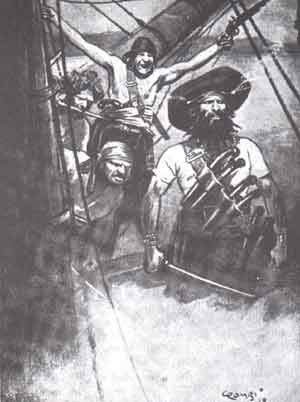
At this point in his life, Blackbeard was about 35 years of age. By all
accounts he was an awesome physical specimen to behold. Standing well over
six feet tall, he must have dwarfed most men. His build was not overly
large but he was said to be immensely strong. Besides his height his most
obvious feature was his beard, which grew "up to his eyes" and
was of tremendous length and breadth. He would twist and braid it into
black ribbons and then tuck them behind his ears. But it was during battle
that Blackbeard was at his most fearsome. Across his chest he would wear
a belt that held multiple matchlock pistols; thus he could have several
loaded guns ready in an instant. The burning fuses used to light the pistols
were tucked beneath his hat, creating large clouds of sulfurous smoke which
made it seem as if he was afire. A broad leather belt supported a further
lethal array of hand weapons which would have included swords, axes, daggers,
and more pistols. He often used a huge musket with which he was a deadly
shot. Blackbeard carefully cultivated his appearance and persona to inspire
maximum awe in his followers and maximum terror in his victims. Pirates
and sailors tended to be a supernatural lot and Blackbeard played on this
by constantly invoking the devil in his oaths and curses.
The Concord was renamed The Queen Anne's Revenge and refitted with
40 guns. Soon Blackbeard was back at sea, taking two large merchantmen in early
1718. The modis operandi was always the same. The Queen Anne would site
potential victims and then begin to maneuver closer to them, trying to ascertain
their quarry's value and ability to defend itself. If the target was tempting
the ship would close, and haul up either a black or red flag emblazoned with
their evil-looking symbol. The meaning of the flag was clear--surrender or die.
The sight of a well-armed warship crowded with fearsome looking men brandishing
their weapons must have been a terrifying one for a merchant crew. This was the
standard pirate tactic--make the threat of violence so horrifying that your victims
would surrender rather than resist. Most of the ships Blackbeard took were merchant
ships packed with cargo and manned with skeleton crews. Some merchantmen were
heavier and armed with cannon but few men would dare stand against Blackbeard.
Making the option of surrender more attractive was that Blackbeard was good for
his word. Captives were treated fairly as long as they didn't resist. There are
no records of Blackbeard maiming or murdering any captives who submitted to him,
and women in particular were treated with respect and care. There are however
numerous examples of Blackbeard bringing murderous abuse on those that opposed
him.
 A few days after taking a large and well-armed merchant man the Queen Anne encountered
the Scarborough, a British man-of-war. A running battle developed
and over the course of the next few hours Blackbeard's gunners out-dueled
and severely damaged their rivals, who were forced to withdraw. Defeating
a military ship was unheard of for a pirate vessel and this incident did
much to enhance Blackbeard's image. After this episode he may or may not
have gone to Bath, NC, to take advantage of a pardon. Whether he did so
or not matters little as he immediately returned to his piratical ways.
He met up with fellow "Brother of the Coast" Stede
Bonnet and soon Blackbeard had built an entire flotilla of pirate ships
under his command. They continued to take prizes seemingly at will. Then
in May, 1718, the Queen Anne and her consorts hove into view off the port of Charleston,
SC, much to the alarm of the local populace. For several days they simply stopped
and looted every ship that tried to pass in or out of the harbor. In doing so
they took several important hostages. Delegates were sent ashore and finally
a ransom was worked out (a trunk of medical supplies), but not before the entire
town had been terrified and humiliated. A few days after taking a large and well-armed merchant man the Queen Anne encountered
the Scarborough, a British man-of-war. A running battle developed
and over the course of the next few hours Blackbeard's gunners out-dueled
and severely damaged their rivals, who were forced to withdraw. Defeating
a military ship was unheard of for a pirate vessel and this incident did
much to enhance Blackbeard's image. After this episode he may or may not
have gone to Bath, NC, to take advantage of a pardon. Whether he did so
or not matters little as he immediately returned to his piratical ways.
He met up with fellow "Brother of the Coast" Stede
Bonnet and soon Blackbeard had built an entire flotilla of pirate ships
under his command. They continued to take prizes seemingly at will. Then
in May, 1718, the Queen Anne and her consorts hove into view off the port of Charleston,
SC, much to the alarm of the local populace. For several days they simply stopped
and looted every ship that tried to pass in or out of the harbor. In doing so
they took several important hostages. Delegates were sent ashore and finally
a ransom was worked out (a trunk of medical supplies), but not before the entire
town had been terrified and humiliated.

The Death of Stede Bonnet |
Blackbeard was at the height of his power. He had
over 300 men under his command and the boats were full of loot.
But bad luck overtook him. The Queen Anne and another ship were
lost on a sandbar in Beaufort Inlet, North Carolina. Many men
were marooned on a deserted island nearby. Whether or not this was treachery
on Blackbeard's part is up for debate, but the end result was Blackbeard
slipping away with the remaining ship, The Adventure,
along with his best crew and most of the loot. Of his abandoned
cohorts, most were saved and regrouped under the command of Stede
Bonnet, "The Gentleman Pirate".
They swore revenge against Blackbeard but were captured by a force of ships
commissioned by the Governor of South Carolina to hunt pirates. Stede Bonnet
and most of his men were hung at Charleston, the very port they had helped
blockade just months earlier.
Meanwhile Blackbeard and his men had landed
in Bath, North Carolina, to divvy up the loot and plan their next move.
Blackbeard wasted no time. He met with his friend, Governor Eden, and soon
had not only a pardon but a beautiful home and young bride. His pirate
cronies scattered over the county and for a time it seemed like Blackbeard
was retired. But he still controlled the waterways of the North Carolina
coast, and in the summer of 1718 held a huge pirate's gathering at Ocacroke
Island, a favorite haunt. Among those in attendance was Charles Vane "the
Insane", a merciless captain who had once hung captives from the rigging
as the ship was set alight. The party lasted for days as the pirates and
their guests ate and drank themselves into a series of comas.
Rumors of
Blackbeard's continued presence in the region infuriated Governor Spotswood
of Virginia, who was also critical of Governor Eden's apparent sponsorship
of this notorious pirate. Spotswood began to collect intelligence and soon
apprehended a former mate of Blackbeard's who was compelled to divulge
the locations of Blackbeard favorite spots in North Carolina. Soon an armed
expedition had been mobilized and charged with the mission of killing Blackbeard.

Teach's Hole, sight of Blackbeard's death |
At sundown on Nov. 21st, 1718, two ships, both flying the British flag, approached
Beaufort Inlet from the north. They were armed sloops under the command of Lieutenant
Robert Maynard, and aboard the boats were close to 60 soldiers. As night fell
the men could see the mast of Blackbeard's ship, The Adventure,
sticking up over an intervening sand dune. Maynard blockaded the inlet
and waited for the morning to launch his attack. A lookout had spotted
the approach of the sloops and Blackbeard prepared his ship for battle.
The sloops drew within hailing range, and Blackbeard cursed them venomously,
damning them as "cowardly puppies"and
demanding to know their identities. He called for a great bowl of punch
and drained it, shouting that no quarter would be given or taken. Blackbeard
was putting on a brave show for someone who had only 15 or so fighting
men. The Adventure cut
cable and began to sail up the channel. Her adversaries moved to cut her off,
only to both run aground. Blackbeard, in his home waters, had lured them onto
a sandbar. As the crews struggled to float their boats, Blackbeard fired an eight-gun
volley of cannon shot into them. The effect was devastating. As many of half
of Maynard's men were either killed outright or badly wounded. The commander
of the other sloop, a Mr. Hyde, was also killed, and his ship disabled until
the end of the fight.
Some accounts state that the recoil from this blast sent Blackbeard's ship onto
a sandbar; in any case he too ran aground. The decks heaped with dead and wounded,
Maynard and his men worked frantically to free their boat before Blackbeard could
reload and fire again. As they cleared the bar, Maynard ordered his men belowdecks
and steered straight for Blackbeard's ship. As the ship drew closer Blackbeard
scanned it's deck piled with bodies and assumed most of the crew was dead. As
the ship drew alongside the pirates threw down a volley of grenades, then Blackbeard
led a boarding party onto the blood-soaked deck of the ship. Suddenly 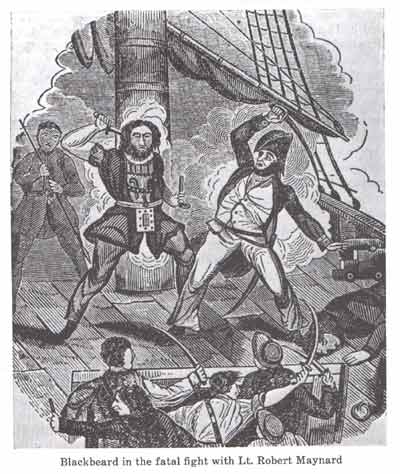 Maynard
and his men charged from the hold of the ship, firing pistols as they rushed
the pirates. What ensued was one of the most savage hand-to-hand combats ever
held on the decks of a ship. Men slashed and hacked as they lurched about the
blood-slicked deck. Pistols were fired at point blank range and the unholy din
of mortal combat filled the air. At the center of this maelstrom Blackbeard and
Maynard charged headlong at each other. Maynard
and his men charged from the hold of the ship, firing pistols as they rushed
the pirates. What ensued was one of the most savage hand-to-hand combats ever
held on the decks of a ship. Men slashed and hacked as they lurched about the
blood-slicked deck. Pistols were fired at point blank range and the unholy din
of mortal combat filled the air. At the center of this maelstrom Blackbeard and
Maynard charged headlong at each other.
Both men drew pistols and fired, but only Maynard hit his mark. His slug tore
through Blackbeard's great body but did not slow down his attack, and
he hacked at his foe with a whirling cutlass. Maynard's sword snapped off at
the hilt, and his hand was cut. Blackbeard closed in but as he raised his weapon
for the deathblow he was struck from behind by a man history names "The Hylander".
Blackbeard had been gashed in the neck by a sword blow that sent blood spurting
from the wound. Blackbeard is said to have congratulated his assailant on the
quality of his blow to which the man replied he felt he could do it better. With
that he struck Blackbeard such a cut that his head "lay upon his shoulder".
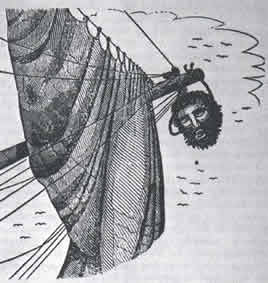 The mightiest of the pirate captains slowly crumpled to the deck, dead from over
25 sword and five pistol wounds. After his head was chopped off his body was
said to have gotten up and jumped over the railing, swimming around the boat
three times before finally sinking. His gory head was lashed to the bowsprint
of the ship and taken back to Virginia, where it was stuck atop a pole. Legends
say that the skull was stolen and made into a fine silver drinking mug that made
appearances in various taverns and fraternity houses before rejoining the rest
of his body in oblivion. The mightiest of the pirate captains slowly crumpled to the deck, dead from over
25 sword and five pistol wounds. After his head was chopped off his body was
said to have gotten up and jumped over the railing, swimming around the boat
three times before finally sinking. His gory head was lashed to the bowsprint
of the ship and taken back to Virginia, where it was stuck atop a pole. Legends
say that the skull was stolen and made into a fine silver drinking mug that made
appearances in various taverns and fraternity houses before rejoining the rest
of his body in oblivion.
Thus ended the life of Edward Teach, and with his passing so went an
era. The death of Blackbeard was the beginning of the end for "The Brotherhood of
the Coast", who one by one would be hunted down and exterminated
over the next several years until their reign of terror was no more.
Blackbeard lived a short and violent life, and try as you might to illuminate
some of his other, less well-known virtues, it's hard to draw any conclusion
other than that this guy was a flipping maniac.
©Dave Brockie |


 Merry Christmas and a Happy New Year from everyone at the LJS Trust