
"Admiral" Sir Henry Morgan 1635-1688
Buccaneer and Governor of Jamaica
Born in Abergavenney, Wales to a military family, he had two uncles who were successful soldiers of fortune. They fought on opposite sides during the English Civil War, Thomas for the parliamentarians, rising to the rank of major-general in the New Model Army, and Edward for the Royalists. After a period of exile before the Restoration, Edward became deputy governor of Jamaica.
Henry Morgan left school early – in his own words “being more used to pike than book”. In early 1655 he ended up being shipped from Bristol to become an apprentice cutler to Timothy Townsend (a Bristol man himself) in Barbados. Life as a servant on a foreign plantation apparently did not agree with him and he promptly escaped to serve as subaltern in Cromwell’s “Western Design”, sailing under Bristol Admiral William Penn.
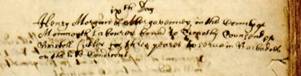
Morgan’s actual entry in an Indentured Servants Book
(Shown with kind permission of Bristol Record Office)
The expedition was initially unsuccessful, they
were repulsed from Santo Domingo with heavy losses,
but they eventually conquered Jamaica late in 1655
to avoid going home empty handed. When Penn and his
joint commander General Robert Venables returned
to England they were briefly thrown into the Tower
of London for dereliction of duty. [Admiral Sir William
Penn’s Tomb is in St Mary Redcliffe Church,
Bristol – resplendent with recently refurbished
battle pennants]
After the English victory Morgan became a captain in
the Jamaican Port Royal Regiment and given a ship with
a privateering commission, sailing with Christopher
Myngs on his raid on Puerto del Principe, here he first
showed his genius as a military strategist. Booty was
scarce however, and his fellow troops were dissatisfied.
He followed this with a brutal raid on Portobelo, Panama,
where he and his buccaneer’s massacred the garrison.
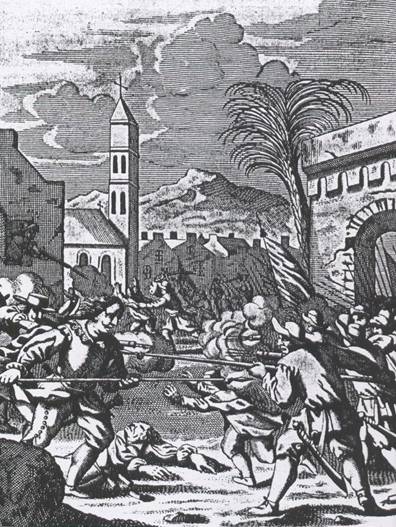
Morgan’s raid on Puerto del Principe that made his name
After these battles he held a meeting of the pirate kings on his flagship, HMS Oxford, but disaster struck and the vessel blew up killing many, but sparing Morgan. The Spanish thought it was just retribution and the work of their Virgin Mary sculpture in Cartagena.
Although not a brilliant seaman, Morgan’s reputation
as a commander was not in question. In 1669 he led
a famous victory at the Bar of Maracaibo where he attacked
the Spanish flagship Magdalena, exploding her
after being set ablaze by a fire ship.

The end of the Magdalena
The highlight of his career was leading a band of
2,000 English and French pirates against the rich port
of Spanish held Panama in 1670/1671. He achieved this
remarkable feat by crossing the Isthmus with a forced
starvation march. After sacking the city, and
with allegations that he had tortured his hostages,
Morgan returned to the Caribbean and made off with
most of the loot.
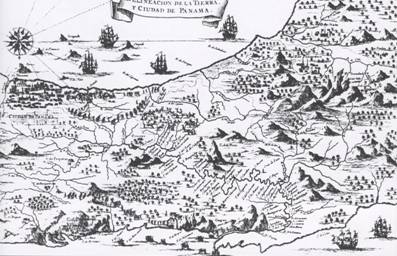
Map of Morgan’s march across the Isthmus of Panama
On his return from Panama the political climate changed
and he was made to return to London to answer charges
of piracy (of all things!). At home though he was treated
as a hero, and despite being under arrest, he led life
in his usual manner, repeatedly exonerated due to his
popularity.
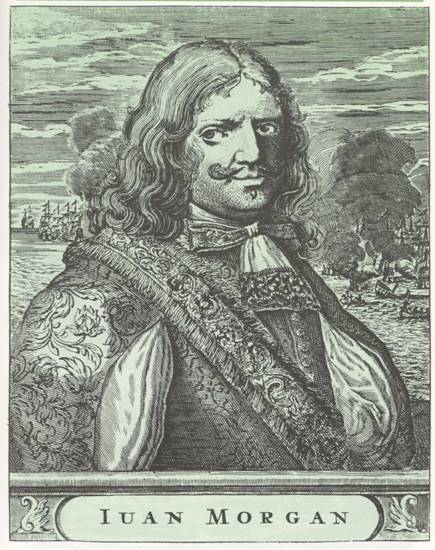
Engraving of Morgan probably done during his exile in England c.1673
Once the political climate changed again, Morgan was knighted by Charles II and sent back to Jamaica where he was appointed Lieutenant Governor. Then under the King’s orders, he proceeded to hang every pirate he could find, including his former henchmen. A classic case of poacher turned gamekeeper.
He was dismissed from official duties due to his heavy drinking in Port Royals taverns. He was described by Sir Hans Sloane (later founder of the British Museum) as ”lean, sallow coloured, his eyes a little yellowish and belly jutting out – much given to drinking and sitting up late”.

Just 4 years after Morgan’s death, an earthquake destroys Port Royal killing over 2000 souls. ‘Devine Retribution’ according to the few Puritan’s left in Jamaica from Cromwell’s Western Design.
Despite being treated by a voodoo man he died in 1688 leaving his wife of 20 years, a huge sugar plantation and £5000. Plus a multitude of rumours regarding Treasure hordes. His body was carried through the streets on a gun carriage, and he was buried in the church he helped found, St Peters.
He was described by author George Wycherly in the 1920’s as “a depraved, vicious, treacherous, almost unparalleled human brute, who was born of respectable people in Wales but deliberately chose the most evil life possible in this vicious age”.
Morgan as we remember him today