
Alexander Selkirk 1680-1721 Part time Pirate, Mariner and Island Monarch
Born in Nether Largo in Fife, Scotland, he ran away from home at 15 after being charged with “undecent behaviour” in church. He went to sea and joined the ill-fated Darien expedition of 1698.
This was Scotland’s attempt at becoming a colonial power and
they cunningly chose a part of Central America which was only 40 miles
wide (giving Scotland control of trade between the Atlantic and the
Pacific). Disease, starvation (they asked the English in Jamaica
for help, but none was forthcoming) and then attack by the Spanish
ended the venture. Of the 1200 colonialists sent out, less than
300 returned but these included Selkirk, now a mariner.
One far reaching consequence of the campaign was
that it nearly bankrupted Scotland and paved the way for union with
England in 1707.
Now a man of the world, he returned home in 1701 only to violently fall out with his family. This time he accepted his punishment and promised “amendment”, and promptly went to sea again, rising to the rank of quartermaster after he joined the Cinque Ports galley on its ill-fated expedition with the St George in 1703.
When Straddling took command he was two years younger than Selkirk and this probably contributed to their strained relationship. Another major problem with the voyage was the poor way in which Dampier led his men. Selkirk, knowing that Dampier knew all about the damage to timber caused by ship’s worms, never forgave him for not sheathing the ships for protection before sailing.
After being marooned on a remote island by Straddling, Selkirk had
four years and four months to dwell upon his bad luck: It’s hard
to imagine what nightmares he must have endured. After Selkirk’s rescue,
Woodes Rogers famously described him as “a man cloth’d
in Goat-skins, who looked wilder than the first owners of them”. Selkirk
had trouble speaking “for want of use” and “he seemed
to speak his words by halves”. Rogers called him the Governor
of the Island and its Absolute Monarch. Dampier recommended him,
and he was appointed Second Mate on the Duke.
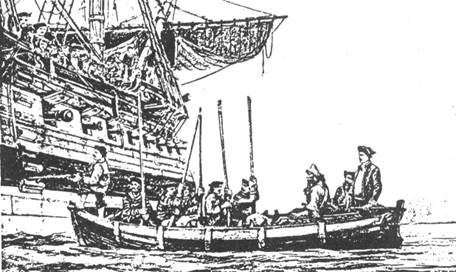
Selkirk being rescued from Juan Fernandez Island by Woodes Rogers’ expedition
Rogers and Selkirk got on well and, on reaching Bristol
after the voyage, Selkirk stayed around hoping to get a berth on a
new expedition for the South Seas Company that Woodes Rogers was trying
to bring to fruition (initially staying in Rogers’ house in
Queens Square). During this time Selkirk wrote a deposition against
Dampier for his role in the St George fiasco. His stay in Bristol
lasted nearly two years until he once again fell foul of the authorities
and ran away after being charged with attacking a fellow sailor in
1713.

One of Selkirk’s haunts in Bristol (just yards from the Star where it is alleged that he met Daniel Defoe)
He went back to Largo a wealthy man, with £800 from his share of the Manila galleon and copies of all the books that had been written about him. He tried to settle and “married” a local girl, but it didn’t work out. He enlisted in the navy and served on HMS Enterprise as mate and then HMS Weymouth as first mate.
Before going on his last voyage he “married” again, leading to all sorts of problems for his first ‘wife’. The mission was to protect Britain’s slaving interests in West Africa , at that time being attacked by pirates, led by “Black Bart” Roberts. It would be another 100 years before the Royal Navy would attack the slave stations.
Weymouth’s sister ship, the Swallow, would lead the successful
attack on the pirates, because the crew of Selkirk’s ship
were stricken with disease. The Island Monarch himself died of
the disease on 13th December 1721.
Coincidently, Woodes Rogers’ only surviving son, William Whetstone
Rogers, went on a slaving voyage on behalf of the Royal African Company,
only to meet the same fate as Selkirk, off of the same West African
coast in 1735.